Costs & funding
How much does CDL training cost?
How much should I budget for CDL training?
The three selected Class A programs in this guide publish charges from $3,500 to $7,500, checked October 26, 2026. They cover different services and are not a national average. If you pay for school yourself, compare itemized tuition, testing and extra fees. If you consider carrier-paid training, compare the employment and repayment terms too. Ask your chosen school for a current written quote.

Published school prices, with the scope beside the number
| Program | Published charge | What to notice |
|---|---|---|
| Shasta College, California | $3,500Course fee | Theory completion and other prerequisites come before registration. The course fee excludes required pre-registration fees; it includes instruction and the stated first-test truck/instructor arrangement. |
| 1 on 1 Truck Academy, California | $7,500Standard program charges | Published Class A program: 120 hours. Registration is included in the total. Conditional promotional pricing is advertised separately; do not assume that rate is available. |
| Johnson County Community College, Kansas | $6,999CDL-A program cost | The college identifies permit/license and student-screening charges outside the program price. Ask which charges apply to your state and circumstances. |
One is a course with prerequisites already completed; another bundles a broader set of instruction and administration. A higher advertised amount may include something you would otherwise pay separately. A lower advertised amount may still be the better choice—but only after you compare the same scope.
Do not calculate a “typical total cost” by averaging these three amounts. The sample is small, selected and not like-for-like. Use the source links to check current terms and request your own written price. No ranking or recommendation of these schools is implied.
Break the bill into parts
Request one itemized price sheet for the exact class, location, schedule and vehicle you plan to use. “ELDT included” is not enough detail: theory and practical training need to be identified separately.
| Item | Ask this question | Price confirmation |
|---|---|---|
| ELDT theory | Is the theory course included, or must I complete it elsewhere first? | Ask the school |
| Range and road instruction | How much time do I personally drive? What does extra practice cost? | Ask the school |
| Permit and license fees | Which state charges do I pay, and when? | Varies by state |
| DOT medical exam | Is the examination arranged and included? Are screenings separate? | Varies by examiner |
| Skills test and truck | Is the first appointment, vehicle and instructor included? What about another attempt? | Ask the school |
The Shasta page publishes a $500 fee for an additional driving-test attempt. 1 on 1’s fee page publishes $645 for a scheduled appointment after the first, split into vehicle/instructor and DMV portions. These are the providers’ own terms, not universal retest fees. Check cancellation and incomplete-test rules too.
From classroom to practice range.
Theory, backing practice and vehicle training happen in different parts of a CDL campus.
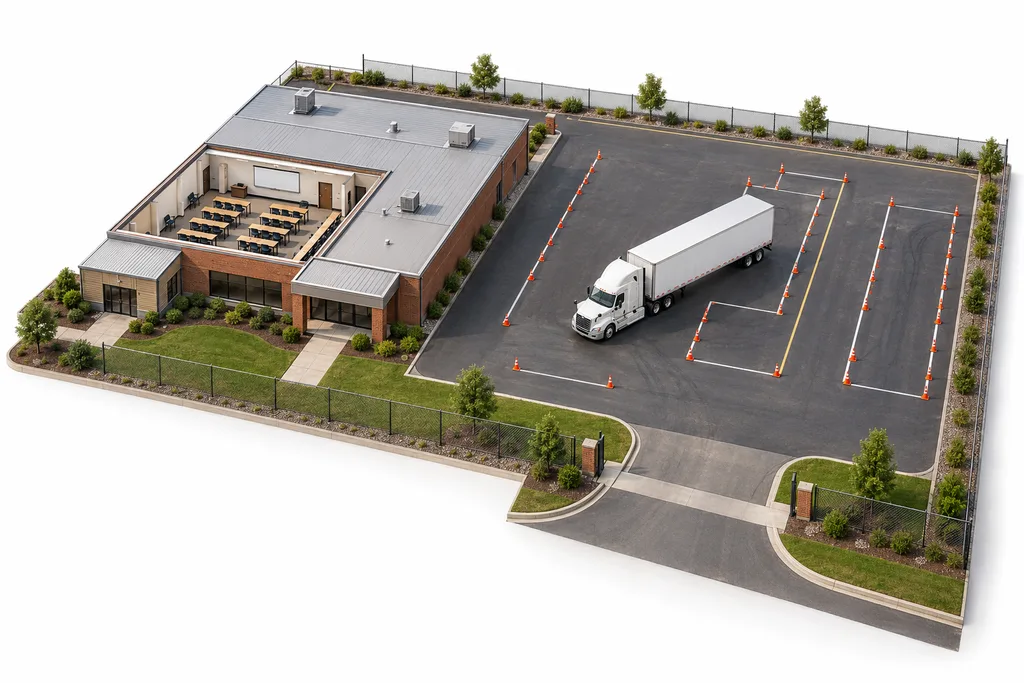
01Classroom and theory
Theory covers vehicle controls, inspections, safe driving, vehicle systems and hours of service. Federal ELDT sets no minimum theory hours; all curriculum topics must be covered and the overall assessment score must reach 80%.
02Closed practice range
Class A range training includes straight-line backing, offset backing, alley-dock backing, parallel parking and coupling. The instructor documents practice hours and proficiency before range completion.
03Training vehicle
Class A training uses a combination vehicle, such as a tractor and semi-trailer. Class B generally covers a single heavy vehicle. The test vehicle must match the license class sought.
04School office
Enrollment staff handle program schedules, fee information and application paperwork. Review the written program terms and total charges here before enrolling.
Sources: FMCSA Class A curriculum, pages 2–3 (March 2021) and California DMV vehicle classes.
Build your own out-of-pocket budget
Enter figures from a written quote. Include a charge only once. Use zero for an item the quote explicitly includes; leave an unknown blank and follow it up. This worksheet does not supply a school price or determine funding eligibility.
Lost earnings are another planning cost. If you reduce work hours to attend training, budget for that income gap separately. The training timeline guide explains why a course end date and a license date may differ.
Ways to pay—and the questions each raises
Workforce grants and scholarships
Ask your local workforce office whether you qualify, whether the exact program is eligible and whether approval must happen before enrollment. Being on FMCSA’s registry does not establish WIOA funding eligibility. JCCC describes several workforce and scholarship routes; availability and individual approval must be checked with the administrator.
Carrier-sponsored training
Ask who pays first and whether you must repay training costs if you leave, do not complete training or cannot start the offered job. Get the employment commitment, deductions, repayment triggers and refund terms in writing. See our carrier-paid training guide before treating a “free” offer as having no financial obligation.
Payment plans and loans
A payment schedule spreads due dates; it does not necessarily reduce the total. Compare the total repayment, interest and fees, required deposits and the effect of withdrawal. A monthly payment by itself does not tell you the cost of financing. The worksheet above adds known amounts; it is not a loan-payment calculation.
Before you sign an enrollment agreement
Take this to each school
Compare the written quote, not just the tuition line
Keep cost and cash timing separate
A program can be affordable in total but difficult to pay for on its required dates. Put each deposit, balance payment and outside fee on a calendar. Then add the confirmed funding payment dates. Do not subtract a pending grant or a possible employer reimbursement as though the cash is already available.
The worksheet shows known amounts, not a guaranteed final bill. It cannot decide whether you need another medical exam, extra practice or a retest. Write those uncertainties beside the quote and ask which would change the price. Keep living expenses and lost earnings in your household plan, rather than treating them as school tuition.
Ask what happens if the plan changes
Read cancellation and withdrawal terms before paying. Ask which payments are refundable, when the calculation changes, whether withdrawing from class cancels a loan and who handles a refund paid by a sponsor. If the school postpones the start date or cannot provide the promised equipment, ask what choices the agreement gives you.
Do not assume a missed test, an unsuccessful attempt and a cancellation have the same charge. Ask separately about the testing agency fee, truck rental, instructor attendance and practice before another appointment. Request the current schedule of fees rather than relying on another student's experience.
Use an identical request for each school
“Please quote the full amount for the Class A program at this location and schedule. List theory, range and road instruction; my individual driving time; materials; first and repeat tests; vehicle use; registration; medical or screening charges; and all exclusions. Include due dates, cancellation terms and the date this price expires.”
Replace Class A with your actual target. If one school requires theory or a permit first and another includes preparation, put that difference beside the total. Compare like-for-like requirements before deciding which offer costs less. The school-selection guide helps compare instruction as well as price, and the funding guide explains the questions to take to a workforce office.
Questions drivers ask
Is there one national price for a CDL?
No. State licensing fees, the training you need and school charges are separate. The selected published charges in this guide are observations of named programs, not a national average or a quote for another school.
What should be in a written CDL school quote?
Identify the exact class, location, schedule, theory and practical instruction, test vehicle, included attempts, extra-practice charges, fees, payment dates and refund terms. Mark every exclusion and ask who receives each payment.
Can I get the whole CDL online?
Online theory does not replace required practical vehicle training or the state skills test. Confirm whether you are buying theory only or a program that also includes range and road instruction.
Can I use a grant to reimburse tuition I already paid?
Do not assume reimbursement. Ask the funding administrator about authorization before enrollment or payment. Individual eligibility, the exact program and local rules must be confirmed in writing.
Is a payment plan cheaper than paying in full?
Not necessarily. Compare total payments, fees and interest as well as the due dates. A smaller monthly payment does not by itself mean a smaller overall cost.
Can this directory quote every school?
No. Registry records do not supply tuition quotes for every location. Published charges are attributed to a named program and date; another location needs its own written quote.
Compare the schools. Then compare the written quotes.
Start with location and training type. Keep the itemized budget alongside your shortlist.
Find CDL schoolsSources and scope
Sources checked Oct 26, 2026. Federal baselines and named state examples are distinguished in the article. Your licensing agency and written program terms govern your case.
- Shasta College: published course fee and prerequisites
- 1 on 1 Truck Academy: fees and payment plan
- JCCC: CDL costs and excluded charges
- FMCSA: selecting an ELDT provider
Prepared by CDLP editorial from the sources above. No independent instructor, legal or financial review is claimed.
Keep planning your next step.
All resources
Paid CDL training: compare the offer and the obligation
Understand sponsored training, reimbursement, pay phases and the agreement before committing.
Read guide
CDL training grants: WIOA, school aid and approval
Find the right funding office, separate eligibility from approval and prepare the documents and cost questions that can prevent an expensive enrollment mistake.
Read guide
How to choose a CDL school: compare training and costs
Check the provider, individual driving practice, test vehicle, total price, schedule and contract before choosing a CDL training program.
Read guide