Planning training
How long does it take to get a CDL?
How long will it take me to get a CDL?
There is no single national completion time. If you can attend weekdays, an accelerated course may suit you; weekend study can spread the training over more weeks. The commercial learner’s permit waiting period, steps you must finish first, test appointments and your progress also affect when you finish. Compare the school’s actual timetable and your state’s requirements before you choose a start date.
Get your state CDL checklist + carrier-paid options
- Free state checklist
- Carrier-paid options
- Email when matching opens in your state
| Your situation | Start with… |
|---|---|
| You need a finish date | Plan the full timeline |
| You work during the week | Compare published schedules |
| You already have a start date | Check likely delays |
Plan the whole timeline, not just the course
- Before the start date Gather the state’s documents, arrange required screenings or certification, prepare for knowledge tests and confirm funding. Ask the school which steps you must finish before the start.
- Permit and training Track the date the CLP is issued. The federal minimum is 14 days holding the permit before taking the skills test. Training and that waiting period may overlap, subject to the rules that apply.
- Skills-test readiness Training completion, the relevant ELDT record and a test appointment are separate checkpoints. Ask whether the quoted course includes scheduling and a test vehicle.
- After the test Confirm the state’s license-issuance process and restrictions. Employer onboarding or further company training can be a separate stage. A license does not assign over-the-road or regional work. Those labels have no BLS wage.
Permit timing: 49 CFR 383.25. Training/testing overview: FMCSA CDL process.
A real example: four weekdays weeks or nine weekend weeks
Johnson County Community College in Kansas publishes two CDL-A formats: a four-week accelerated weekday course and a nine-week weekend course. Its program page describes 160 hours combining classroom, online study and behind-the-wheel training. These are one college’s listed schedules, not an average for the country or a guarantee of available places.
| Format | Published attendance | Planning question |
|---|---|---|
| Accelerated | 4 weeks, Monday–Friday | Can you attend the full weekday schedule and complete required prior steps? |
| Weekend | 9 weeks, Saturday–Sunday | Can you protect both weekend days for the course and fit study around work? |
Sources: JCCC schedule and entry steps and program overview. Confirm the next cohort and exact timetable with the college. Other schools whose own pages named a weekend or evening class on October 29, 2026 are listed in weekend and evening CDL classes.
Total course hours are not individual driving hours
A program may include online theory, classroom instruction, vehicle inspection practice, observation and actual driving. Ask for these components separately. “160 hours of training” does not, by itself, mean 160 hours personally driving a truck.
More about Total course hours are not individual driving hours
Federal ELDT rules set no minimum hours for theory or driving training. Theory must cover all required topics. The overall test score must be at least 80%. Hands-on completion depends on the instructor’s check of your skills. States may add requirements. So check the school’s plan for supervised driving and extra practice.
Sources: FMCSA training requirements FAQ and driver FAQ. An online theory certificate does not replace hands-on training.
From classroom to practice range.
Theory, backing practice and vehicle training happen in different parts of a CDL campus.
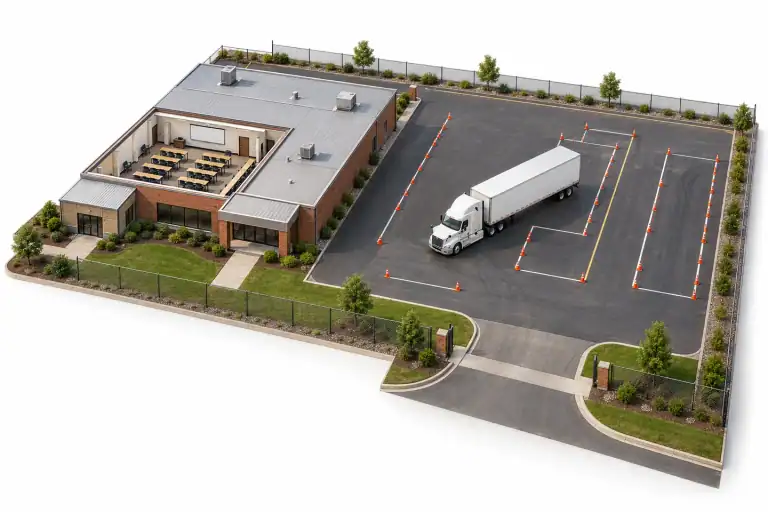
01Classroom and theory
Theory covers vehicle controls, inspections, safe driving, vehicle systems and hours of service. Federal ELDT sets no minimum theory hours; all curriculum topics must be covered and the overall assessment score must reach 80%.
02Closed practice range
Class A range training includes straight-line backing, offset backing, alley-dock backing, parallel parking and coupling. The instructor documents practice hours and proficiency before range completion.
03Training vehicle
Class A training uses a combination vehicle, such as a tractor and semi-trailer. Class B generally covers a single heavy vehicle. The test vehicle must match the license class sought.
04School office
Enrollment staff handle program schedules, fee information and application paperwork. Review the written program terms and total charges here before enrolling.
Sources: FMCSA Class A curriculum, pages 2–3 (March 2021) and California DMV vehicle classes.
Find the gaps that can move your finish date
Before taking leave from work, ask for the earliest realistic test date and what it depends on. A training finish date can arrive before a test slot is available. A missing permit or training record can cause a gap. So can a missing truck or more practice, even if you attended every class.
More about Find the gaps that can move your finish date
Ask what happens after an unsuccessful test attempt. Who books the next appointment? Can you practice before it? What do the truck and instructor cost? The cost guide helps you record those charges alongside tuition.
Your planning checklist
Before committing to a schedule, use the school comparison checklist for driving time, total price and refunds.
Get these dates and answers in writing
Leave room for changes to transport, child care and work plans. Ask more than “How many weeks?” Ask which steps you will finish and what remains before you get a license.
Compare scheduled hours with elapsed calendar time
If a hypothetical course schedules 160 hours of instruction at 40 hours a week, the arithmetic is four teaching weeks. At 20 hours a week, it is eight teaching weeks. Neither calculation includes an unscheduled start, missed sessions, extra instruction, reporting delays or open test dates. It also does not prove that 160 hours is a universal legal requirement.
More about Compare scheduled hours with elapsed calendar time
Ask the provider to mark the calendar instead of simply divide the advertised hours. Which days are theory, range and road instruction? How are holidays and missed sessions handled? When could you first test if every step you must finish first is complete? A real calendar exposes conflicts that an “X-week course” label can hide.
If you are keeping a job while training, include travel and preparation time. A schedule that looks faster on paper may be harder to complete if it creates repeated attendance problems. Choose a plan you can sustain, not just the smallest week count.
What commonly delays the path from enrollment to testing?
- Application preparation: unresolved documents, required screening or an appointment that was not booked.
- Training availability: a future cohort start, a practical-course gap after separate theory or a schedule change.
- Practice needs: extra training needed before the provider can confirm proficiency.
- Reporting: a missing or mismatched training record that needs correction.
- Testing: an appointment and access to a suitable test vehicle, cancellation or a retest.
These are planning categories, not measured delay probabilities. Ask who owns each handoff and what evidence means it is complete. A school’s estimated finish date is easier to evaluate when it shows the assumptions behind it.
Keep a small buffer in your personal plan for a step that may move. If the start date affects housing, unpaid leave or childcare, confirm the change policy before paying those costs. Do not treat a marketing timeline as a guarantee for those separate commitments.
How do you get a usable completion estimate from a school?
Ask for two dates: the planned instructional finish and the earliest realistic test date assuming steps you must finish first are complete. Then ask what could move either date and whether extra instruction or a retest would add charges. Keep the answer with the course schedule and agreement.
More about How do you get a usable completion estimate from a school?
Use the same assumptions for every program in your shortlist. One provider may quote instructional weeks while another includes a later testing stage. You cannot compare those figures fairly until they describe the same endpoint.
For employment planning, add the employer’s onboarding or supervised-work phase separately. A CDL test date is not necessarily the date of a first solo assignment or first paycheck. The paid-training guide explains why different pay phases and work commitments need their own questions.
Questions drivers ask
Can I get a CDL in two weeks?
Do not treat a minimum permit holding period or a short course advertisement as a complete personal timeline. Training proficiency, steps you must finish first and open test dates still matter.
Is a 160-hour program always four weeks?
Only if its actual schedule delivers 40 hours each week without other gaps. The hour count does not by itself establish elapsed time or a legal minimum.
Does weekend training take longer?
It may deliver fewer scheduled hours per week, but the actual calendar, attendance and test arrangements determine the comparison. Ask for dated schedules.
Does finishing school mean I am licensed that day?
Not necessarily. Required records, testing and state issuance are separate checkpoints. Ask which endpoint the school’s completion estimate describes.
What should I ask about a promised start date?
Check the class group, required prior steps and refund/change policy. What happens if you or the provider must move the date?
Sources and scope
Source links, check date and scope
Sources checked Oct 26, 2026. Federal baselines and named state examples are distinguished in the article. Your licensing agency and written program terms govern your case.
- FMCSA: ELDT overview
- 49 CFR 383.25: permit conditions
- JCCC: published program formats
- FMCSA: training record reporting
Prepared by CDLP editorial from the sources above. No independent instructor, legal or financial review is claimed.
Get matched with CDL schools near you
Get your state CDL checklist + carrier-paid options
- Free state checklist
- Carrier-paid options
- Email when matching opens in your state
Keep planning your next step.
All resources
Paid CDL training: compare the offer and the obligation
Understand sponsored training, reimbursement, pay phases and the agreement before committing.
Read guide
How to get a CDL learner’s permit (CLP)
Understand what a CLP allows, which tests to prepare for, what to bring and how to turn practice mistakes into a useful study plan.
Read guide
ELDT training: requirements, online theory and records
Separate ELDT theory from hands-on training, check who must complete it and avoid buying a course that does not cover your next licensing step.
Read guide