Getting started
How to get a CDL, step by step
How do I get a CDL?
Start with the vehicle you want to drive and your state’s license rules. For a first Class A or Class B CDL, plan for a commercial learner’s permit, applicable entry-level driver training, supervised practice and a skills test. If you already hold a CDL, check which upgrade or endorsement requirements apply. A school completion certificate alone is not a CDL.
Get your state CDL checklist + carrier-paid options
- Free state checklist
- Carrier-paid options
- Email when matching opens in your state
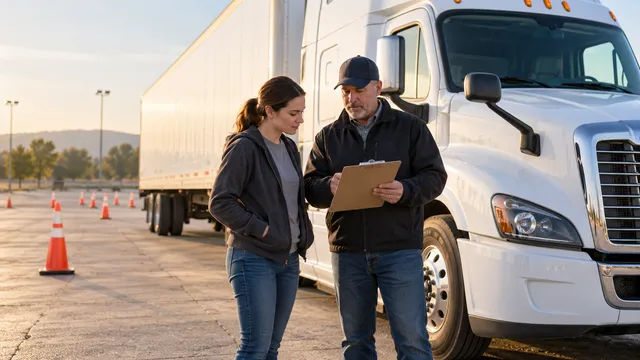
Try the free cdl permit practice test. Study the explanations, then check your state manual.
| Your situation | Start with… |
|---|---|
| You need your first CDL | Follow the CDL steps |
| You have not picked a vehicle class | Compare Class A, B and C |
| You already hold a CDL | Check the added tests and training |
What is a CDL?
Turn these steps into a personal dated checklist with the CDL readiness quiz.
A commercial driver’s license (CDL) is the state-issued license for driving vehicles that meet the federal commercial vehicle groups. Federal rules set the minimum standards; your state processes the application and issues the credential.
- Class A: combinations rated or weighing at least 26,001 pounds, with a towed unit over 10,000 pounds.
- Class B: single vehicles rated or weighing at least 26,001 pounds, towing no more than 10,000 pounds.
- Class C: vehicles outside A/B that carry 16 or more people including the driver, or qualifying hazardous materials.
Use the greater of rating or actual weight for the weight tests. Source: 49 CFR 383.91 and FMCSA driver overview, checked November 2, 2026. Check exemptions and the actual vehicle before choosing a course.
If you are under 21, use the age decision table and checked state minimums before planning interstate work.
Your route to a CDL
- Choose the class and endorsements.
Match the actual vehicle and work to the license. Passenger, school bus and hazardous materials requirements are separate from the A/B/C class.
- Check your state’s rules for applying.
Use the state license office’s current checklist. Check ID, home address, driving record, medical certificate and the knowledge tests for your vehicle.
- Earn the commercial learner’s permit.
The CLP lets you practice under required supervision. It is not permission to drive a commercial vehicle independently.
- Complete the training that applies to you.
Confirm the provider and training type on the FMCSA Training Provider Registry. Theory and hands-on training are different parts.
- Pass the skills test and complete state issuance.
Check whether you can take the test, the vehicle, documents and appointment arrangements. Confirm what happens after passing before you accept driving work.
Federal process: FMCSA: getting a CDL. State requirements can add steps.
Compare the groups in Class A vs Class B, then read Class A CDL training, Class B CDL training, or Class C before you choose a course. Hazardous materials and tank cargo are separate privileges: see the hazmat endorsement and tanker endorsement guides.
Do the paperwork before buying a course
Begin with your home state’s CDL page and its current driver handbook. Ask which documents you need, which knowledge tests apply, and what medical certification the driving you plan to do requires. The school can help you organize these steps; the state license office decides whether your request is acceptable.
More about Do the paperwork before buying a course
For a concrete state example, Texas DPS lists its permit and CDL application process. Do not treat that list as the checklist for another state. If your case involves an exception or a special licensing category, get the state’s answer before paying a charge you cannot get back.
Keep the permit date visible in your plan. The federal baseline requires holding a CLP for at least 14 days before the skills test. That is a minimum wait, not a promise that you can learn, book and pass everything in two weeks. See 49 CFR 383.25.
Choose the training, not just the school name
First-time Class A and Class B applicants are among the drivers covered by ELDT. Online training can cover theory. It does not replace range or public-road time. Other covered cases include a B-to-A upgrade and first-time H, P or S endorsements.
More about Choose the training, not just the school name
The training required depends on the application; an H endorsement does not have the same practical-training requirement as a first Class A license. Check FMCSA’s driver-specific ELDT guidance for your case. Military CMV experience can change the skills test and the training rule when 49 CFR 383.77 applies.
Read CDL training for veterans before treating a job title as a waiver.
Ask the location to describe the course in writing: theory, closed-range practice, road training, your own driving time and the test vehicle. A TPR listing is a starting point for checking training scope. It is not accreditation, a pass-rate claim or confirmation that the location enrolls the public.
From classroom to practice range.
Theory, backing practice and vehicle training happen in different parts of a CDL campus.
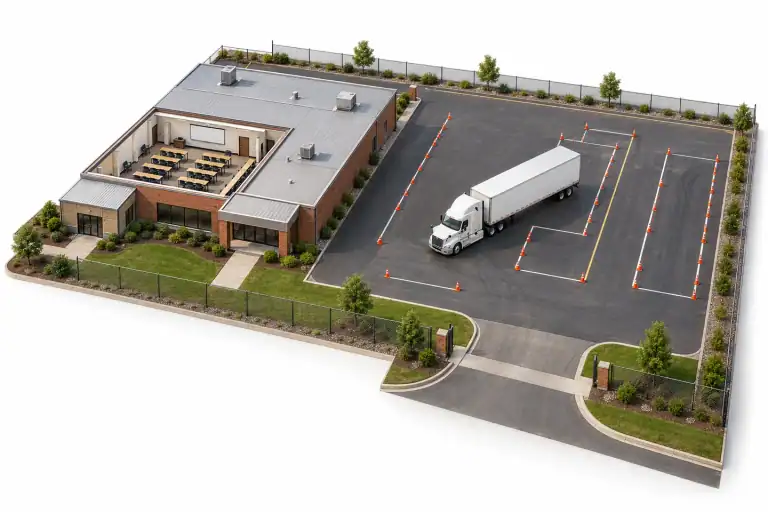
01Classroom and theory
Theory covers vehicle controls, inspections, safe driving, vehicle systems and hours of service. Federal ELDT sets no minimum theory hours; all curriculum topics must be covered and the overall assessment score must reach 80%.
02Closed practice range
Class A range training includes straight-line backing, offset backing, alley-dock backing, parallel parking and coupling. The instructor documents practice hours and proficiency before range completion.
03Training vehicle
Class A training uses a combination vehicle, such as a tractor and semi-trailer. Class B generally covers a single heavy vehicle. The test vehicle must match the license class sought.
04School office
Enrollment staff handle program schedules, fee information and application paperwork. Review the written program terms and total charges here before enrolling.
Sources: FMCSA Class A curriculum, pages 2–3 (March 2021) and California DMV vehicle classes.
Theory can be provided separately from hands-on training, provided the relevant providers meet registry requirements. Confirm who reports each completion and check your training record before the test. Do not buy an online theory course assuming it includes hands-on vehicle training.
Plan the test while you plan the course
Ask who books the appointment, who supplies the vehicle for your test, and whether its gears or equipment could affect the license restrictions you receive. The skills test guide covers the inspection, the control exercises, and the on-road drive. Confirm the charge for a missed appointment, extra practice and another test attempt. Those details can change both your budget and your completion date.
More about Plan the test while you plan the course
Use your state handbook as the study reference. Practice questions can help you identify gaps, but memorizing answers does not replace knowing the vehicle or meeting the test standard. Our practice questions include explanations and source notes.
Where a state has published its own knowledge-test count, that note is on the state CDL practice test pages. If you already hold a CDL and it has lapsed, the refresher guide compares the federal renewal rule with two states’ retest cutoffs.
It does not name a course length.
Your next-step checklist
Before you enroll
Before setting a start date, check these guides. State licensing pages are published only where an official source was opened.
- Class A/B comparison
- cost guide
- training timeline
- how to get a CDL in your state
- federal CDL requirements
- federal eligibility check
- CDL disqualifications
- non-domiciled CDLs
- metro employment notes for local-job searches
- what “no experience” means in the BLS handbook
- how Class B differs from a BLS occupation
Employment and wages by state
May 2025 OEWS estimates for heavy and light truck drivers are published by state. They are wage-and-salary employment, not openings.
- Alabama
- Alaska
- Arizona
- Arkansas
- California
- Colorado
- Connecticut
- Delaware
- District of Columbia
- Florida
- Georgia
- Hawaii
- Idaho
- Illinois
- Indiana
- Iowa
- Kansas
- Kentucky
- Louisiana
- Maine
- Maryland
- Massachusetts
- Michigan
- Minnesota
- Mississippi
- Missouri
- Montana
- Nebraska
- Nevada
- New Hampshire
- New Jersey
- New Mexico
- New York
- North Carolina
- North Dakota
- Ohio
- Oklahoma
- Oregon
- Pennsylvania
- Rhode Island
- South Carolina
- South Dakota
- Tennessee
- Texas
- Utah
- Vermont
- Virginia
- Washington
- West Virginia
- Wisconsin
- Wyoming
Can you get a CDL without going to a traditional school?
A traditional tuition-based campus is not the only possible training setting. Employer-based and other registered providers can offer training. But for a covered first Class A or B application, avoiding a traditional school does not remove the applicable ELDT requirement. A practice partner and an online question bank are not substitutes for required training and reported completion.
More about Can you get a CDL without going to a traditional school?
Ask two separate questions: “Am I covered by ELDT for this application?” and “Which registered provider will complete and report each required component?” If someone advertises a shortcut, check with the state before paying. Ask how that route meets the current rules. See the ELDT guide for the difference between online theory and hands-on training.
Turn the steps into a plan you can actually follow
Put each required step next to the office that handles it. Your state handles the license. The provider delivers and reports training. An examiner handles the test. Each employer makes its own hiring decision. One office’s approval does not settle the other decisions.
| Handoff | Confirmation to keep |
|---|---|
| Application to permit | Required documents, tests, permit conditions and dates. |
| Permit to instruction | Course scope, schedule, vehicle and what you must bring. |
| Training to testing | Reported completion, whether you can take the test, appointment and vehicle arrangements. |
| License to employment | Actual privileges/restrictions and the specific employer’s requirements. |
Resolve the expensive dependencies first. If a course start depends on a permit or a funding authorization, do not assume those decisions will arrive before a nonrefundable deadline. Ask what happens if one step is delayed and which charges can be refunded or moved.
More about Turn the steps into a plan you can actually follow
If your case involves a previous CDL, a military pathway, a changed status or an exception, bring the details to the state license office. A general step-by-step article cannot decide an individual exception from a few facts. Get the answer for your actual application instead of starting over based on an unrelated online story.
Getting the license and getting the job are separate milestones
Before accepting work, read the license you were issued. Confirm that the class, endorsements and restrictions fit the vehicle and operation. If a future job requires equipment that differs from your test vehicle, ask about that gap before assuming you can start.
More about Getting the license and getting the job are separate milestones
Keep the job offer separate from any school placement statement. Ask about screening, experience, training after hire, pay phases, route and home time. A school certificate or a CDL does not prove that an employer has accepted you. The pay-offer guide helps you compare the actual offer instead of an advertised maximum.
Your useful next step is the first unresolved requirement in the plan—not necessarily buying a longer course. Use the checklist, keep the relevant documents together and return to the responsible organization when something does not match.
Questions drivers ask
What is the difference between a CLP and a CDL?
The CLP is a supervised learning credential with conditions. The CDL is the license issued after the rules that apply are completed, with its own class, endorsements and restrictions.
Can I get a CDL entirely online?
No online course replaces required practical vehicle training or the state skills test. Online theory can be one component of a training path that applies.
Does a school certificate mean I can start driving for work?
No. Confirm state license issuance and your actual privileges, then meet the specific employer’s requirements. Training completion and a hiring decision are separate.
Can an employer provide the training instead of a private school?
A registered provider may offer employer-based training. Confirm the type of training that applies, reporting and program terms instead of assuming every employer arrangement qualifies.
What should I do first if my application is unusual?
Ask the state license office about your exact history and intended license change before paying for a course. Exceptions and state-specific requirements should be resolved for your case.
Sources and scope
Source links, check date and scope
Sources checked Oct 26, 2026. Federal baselines and named state examples are distinguished in the article. Your licensing agency and written program terms govern your case.
- FMCSA: how to get a CDL
- FMCSA: ELDT applicability
- 49 CFR 383.25: learner permits
- Texas DPS: application example
Prepared by CDLP editorial from the sources above. No independent instructor, legal or financial review is claimed.
Get matched with CDL schools near you
Get your state CDL checklist + carrier-paid options
- Free state checklist
- Carrier-paid options
- Email when matching opens in your state
Keep planning your next step.
All resources
How to get a CDL learner’s permit (CLP)
Understand what a CLP allows, which tests to prepare for, what to bring and how to turn practice mistakes into a useful study plan.
Read guide
ELDT training: requirements, online theory and records
Separate ELDT theory from hands-on training, check who must complete it and avoid buying a course that does not cover your next licensing step.
Read guideCDL age: 18, under 21 and interstate
Use the age decision table and sourced state minimums before planning training or driving work.
Read guide