License classes
Class B CDL training
What is Class B CDL training?
Class B is the federal group for a single vehicle whose rating or actual weight, whichever is greater, is 26,001 pounds or more. It may tow a unit of 10,000 pounds or less. A first Class B applicant needs a commercial learner’s permit, applicable entry-level driver training and a skills test. A bus or box truck is not automatically Class B. Compare the named examples with your own written quote.
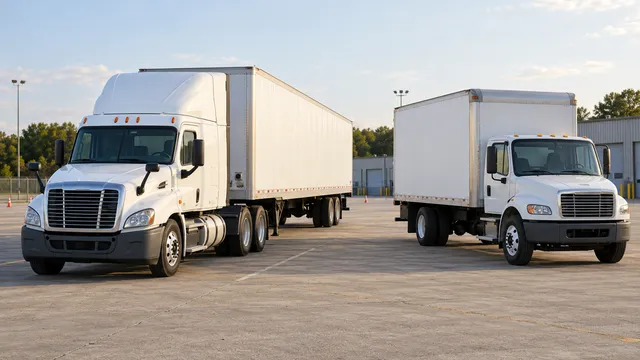
What a Class B CDL lets you drive
FMCSA describes Class B as any single vehicle with a gross vehicle weight rating or gross vehicle weight of 26,001 pounds or more, or any such vehicle towing a vehicle that does not exceed 10,000 pounds. A combination is Class A only when its combined rating or actual weight, whichever is greater, is 26,001 pounds or more and the towed unit is over 10,000 pounds. A heavier trailer alone does not make a lighter combination Class A.
Source: FMCSA driver overview, page updated February 4, 2026. See also 49 CFR 383.91.
A heavy straight truck is the usual way to picture Class B. A bus is Class B only when it meets that weight rule. A smaller vehicle designed to carry 16 or more people, including the driver, can fall under Class C instead. Hazardous-materials placarding can also put a vehicle that is outside Class A and Class B into Class C. Read the ratings and the cargo. Do not decide from the body style.
Passenger work still needs the P endorsement, school-bus work needs both the P and S endorsements, and, for a first-time applicant, the applicable entry-level training. FMCSA says a Class B holder who tests for passenger or school bus in a Class C vehicle gets an N restriction and may only operate Class C passenger vehicles or school buses. Air-brake and automatic-transmission restrictions can apply here too. The endorsement guide separates those letters from the license class. Tank and hazardous-materials rules are in the tanker and hazmat guides.
If the job is a tractor-trailer, use Class A CDL training and the Class A vs Class B comparison.
What FMCSA requires for a first Class B CDL
The state issues the license. For a first Class B CDL, FMCSA’s federal baseline matches the Class A sequence, with a different vehicle group:
- Use your state’s current CDL manual and confirm which knowledge tests apply. Combination-vehicle knowledge is part of a Class A path, not an automatic Class B test.
- Get a commercial learner’s permit and practice only with the required qualified CDL holder.
- Finish entry-level driver training with a registered provider before the skills test if you are getting a Class B CDL for the first time and your permit was issued on or after February 7, 2022. Theory does not have to be finished before the permit application under the federal rule. States may require more.
- Hold the permit at least 14 days, then pass the vehicle inspection, basic controls and road test in a representative vehicle.
Sources: FMCSA, how to get a CDL, updated December 8, 2025; 49 CFR 383.25; FMCSA driver overview.
Knowledge tests require at least 80 percent under 49 CFR 383.135. 49 CFR 391.11(b)(1) sets 21 as the minimum age to drive a commercial motor vehicle for a motor carrier covered by that part. The state decides the age for the license you are applying for. Start with the permit guide and the general knowledge and air brakes practice sets.
Get your CDL paid for
Get notified when carrier-paid CDL matching opens in your state, plus tips on payback contracts and getting hired with no experience.
How long Class B training takes
There is no federal hour minimum for entry-level driver training. The 14-day permit period is a waiting rule, not the length of school. These two published Class B schedules were checked on October 28, 2026. Locations whose registry record lists theory and not behind-the-wheel are on the online training guide. That list does not say the theory is taught online.
| Program | Published length | What the page also says |
|---|---|---|
| Aims Community College, Fort Lupton, Colorado | 28 hours, 8 a.m.–4 p.m., Monday–Thursday. One listed course is November 9–12, 2026. | Course cost is $1,800. A separate $120 orientation fee covers the background check and drug test. Later dates are listed for 2027. Confirm the seat before you rely on a date. |
| 1 on 1 Truck Academy, West Sacramento, California | 90 hours for the standard Class B program. | The standard total is $7,500, the same standard total as the school’s 120-hour Class A program. Conditional promotional pricing is advertised separately. |
Twenty-eight hours and ninety hours are not interchangeable courses. Ask what share of the hours you spend driving, and whether a passenger or school-bus endorsement is included. The timeline guide explains how to compare calendars that are not like-for-like.
Published Class B charges, not a national range
FMCSA does not publish tuition. The charges below are the schools’ own standard figures as of October 28, 2026. The distance between $1,800 and $7,500 is not a market range you can shop against. It is two named programs with different lengths.
| Program | Published standard charge | Keep separate |
|---|---|---|
| Aims Community College | $1,800 Class B course cost for 28 hours | $120 orientation fee. This is not the college’s $3,500 Class A course. |
| 1 on 1 Truck Academy | $7,500 standard total for the 90-hour Class B program | Itemized as $7,250 tuition plus $250 registration included in the total. Appointments after the first DMV test are extra. Do not substitute the school’s conditional promotion for this standard total. |
Build the rest of the budget with the cost guide. If an employer offers to pay, read carrier-paid training before you sign.
Pay figures that are easy to misread
BLS does not report wages for Class B license holders. Bus driving is one occupation where a Class B CDL is sometimes required, and sometimes is not, because the vehicle class depends on weight. For May 2025, BLS reports these medians:
| Occupation | Median annual wage |
|---|---|
| Bus drivers, school | $47,920 |
| Bus drivers, transit and intercity | $59,050 |
Source: BLS Occupational Outlook Handbook, bus drivers, checked October 28, 2026. School bus drivers’ lowest 10 percent earned less than $29,240, and the highest 10 percent earned more than $65,730. Transit and intercity bus drivers’ lowest 10 percent earned less than $40,030, and the highest 10 percent earned more than $84,700.
Heavy and tractor-trailer truck drivers, the occupation closer to Class A combination work, had a May 2025 median of $58,640. That figure is explained on the Class A page and in the pay-offer guide. Do not use either median as the wage for a straight-truck job you have not been offered.
Find a school, a city page or a practice set
Filter the directory for Class B, then confirm the vehicle, endorsements and price. City pages below show listed training locations. They are starting points, not a claim that each city is the best place to train.
Questions drivers ask
Is every box truck or bus a Class B vehicle?
No. Class B is a weight-rating group: a single vehicle of 26,001 pounds or more, which may tow a unit of 10,000 pounds or less. A smaller bus designed for 16 or more passengers can be Class C. Check the vehicle’s ratings with your state.
Does Class B include a tractor-trailer?
Not when the combination’s rating or actual weight, whichever is greater, is 26,001 pounds or more and the towed unit is over 10,000 pounds. That is Class A. A towed unit over 10,000 pounds does not by itself make a lighter combination Class A. A Class B license also does not add passenger, school-bus or hazardous-materials endorsements by itself.
How long and how much is Class B CDL training?
FMCSA sets no national hour count or tuition. Aims Community College lists a 28-hour Class B course at $1,800, plus a separate $120 orientation fee. 1 on 1 Truck Academy lists 90 hours and a $7,500 standard total for Class B. Both pages were checked October 28, 2026. They are not a national range.
What do Class B drivers get paid?
BLS does not publish a Class B wage. It does publish May 2025 medians for bus drivers: $47,920 for school bus drivers and $59,050 for transit and intercity bus drivers. Those occupations are not the same as every Class B job, and a bus is not automatically Class B.
Can I upgrade from Class B to Class A later?
Yes, there is an upgrade path. FMCSA includes a Class B to Class A upgrade in entry-level driver training when the rule applies. The state still sets the tests, and you should price that later training before choosing a Class B course only to save money now.
Confirm the vehicle before you compare prices.
A lower Class B charge can be the wrong course if the job needs a combination vehicle or a passenger endorsement.
Search Class B schoolsSources and scope
Sources checked Oct 28, 2026. Federal baselines and named state examples are distinguished in the article. Your licensing agency and written program terms govern your case.
- FMCSA: CDL classes, endorsements and restrictions
- FMCSA: how to get a CDL
- 49 CFR 383.25: commercial learner’s permit
- 49 CFR 383.135: knowledge-test passing score
- 49 CFR 391.11: general driver qualifications
- FMCSA: entry-level driver training
- Aims Community College: CDL Class A and Class B
- 1 on 1 Truck Academy: fees and payment plan
- BLS: bus drivers
Prepared by CDLP editorial from the sources above. No independent instructor, legal or financial review is claimed.
Get your CDL paid for
Get notified when carrier-paid CDL matching opens in your state, plus tips on payback contracts and getting hired with no experience.
Keep planning your next step.
All resources
What does CDL training really cost?
Published program charges, extra fees and a worksheet for comparing written quotes.
Read guideClass A vs Class B CDL: which license do you need?
A vehicle-based comparison, with endorsements and restrictions explained separately.
Read guide
Class A CDL training
What a Class A CDL covers, the federal steps, and published training time, cost and pay figures.
Read guide