License classes
Box truck CDL: weight and license rules
Do you need a CDL to drive a box truck?
It depends on the vehicle and operation. A single box truck rated at 26,001 pounds or more generally falls in Class B; a qualifying heavy combination with a trailer over 10,000 pounds falls in Class A.
Smaller trucks can still require a CDL for qualifying hazardous materials or passenger use. A box truck below CDL weight may still be a federal commercial vehicle. Its driver may need a medical card for work across state lines.
Check ratings, actual weight, cargo and state rules before driving.
Get your state CDL checklist + carrier-paid options
- Free state checklist
- Carrier-paid options
- Email when matching opens in your state
| Your situation | Start with… |
|---|---|
| You know the truck and trailer weights | Check the ratings together |
| The truck is below CDL weight | Check separate medical rules |
| You carry people or hazmat | Check rules beyond weight |
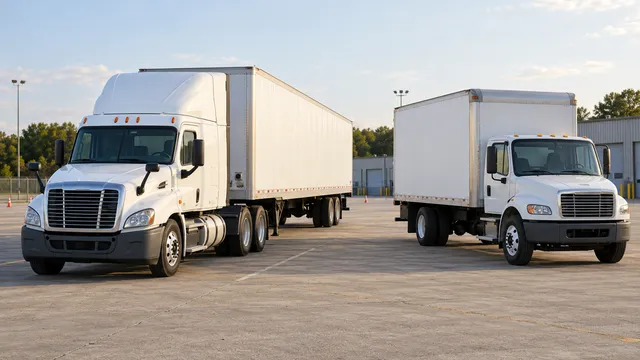
“Box truck” describes the body, not the license. Two trucks that look alike can have different ratings and uses. Find the manufacturer’s gross vehicle weight rating (GVWR). For towing, find the gross combination weight rating (GCWR) and trailer rating too.
Use the license-class comparison before choosing training. If a CDL is needed, begin with free general knowledge practice. Federal definitions checked November 2, 2026. For a multi-jurisdiction business, check the separate axle and weight tests for fuel-tax licensing too.
Read the truck and trailer ratings together
| Vehicle or operation | Federal CDL group |
|---|---|
| Single truck: GVWR 26,001 lb or more | Class B; may tow a unit rated 10,000 lb or less. |
| Combination: GCWR 26,001 lb or more, towed unit GVWR over 10,000 lb | Class A. |
| Below A/B weight groups, carrying qualifying hazardous materials | Class C with the appropriate hazmat privilege. |
| Below A/B weight groups, designed for 16 or more people including driver | Class C with passenger endorsement. |
| Below A/B groups, no passenger or hazmat trigger | No federal CDL based on those criteria; check state license and commercial-operation rules. |
49 CFR 383.91 sets the groups. 49 CFR 383.5 also defines a CDL commercial motor vehicle. Its weight tests use rating or actual weight, whichever is greater. An empty truck is not automatically exempt, and actual loading can matter. Give the state the full truck and trailer setup. Do not rely on an ad’s “non-CDL” label.
When Class B is the next step
A qualifying heavy single box truck points to Class B training and licensing. Check brakes, gears and towing plans before choosing a test vehicle. The license class alone does not settle every equipment or endorsement limit.
For work planning, the Class B job guide explains how to compare vehicle and route expectations. Ask the employer for the actual truck’s rating and setup. A job category does not tell you the vehicle’s specs.
A non-CDL truck can still need medical qualification
Part 390 defines commercial vehicles for work across state lines. Its weight test starts at 10,001 pounds. Use rating or actual weight, whichever is greater. That threshold is lower than the heavy-vehicle CDL threshold. So a covered driver may need a medical examiner’s certificate under 49 CFR 391.41 while driving a truck that does not require a CDL.
More about A non-CDL truck can still need medical qualification
Source: 49 CFR 390.5 definitions and §391.41, checked November 2, 2026. This is 10,001 pounds or more, not strictly more than 10,001. Check if the rule applies and whether an exception fits. State rules for work within one state can differ. Check the work with the carrier and state. “Non-CDL” does not remove all DOT duties.
Cargo and passengers can change the answer
The small-vehicle CDL group includes vehicles designed for at least 16 people, including the driver. It also includes vehicles carrying hazmat within the CDL definition. For hazmat, that includes material requiring placards and specified select agents or toxins under 49 CFR 383.5. A small vehicle is not automatically outside the CDL system.
More about Cargo and passengers can change the answer
Ask the employer which cargo is allowed and which endorsements you need. Check before you accept a load. This weight table cannot decide if a shipment needs placards. That is a separate question about the cargo class.
What a “non-CDL box truck” job description tells you
Usually it signals that the advertised assignment does not require a CDL. It does not prove the truck’s exact rating or medical rule. It cannot confirm insurance eligibility or rules for a different route. Ask for the vehicle, cargo, interstate status and license class in writing.
More about What a “non-CDL box truck” job description tells you
If the assignment requires a license you do not hold, use the training-location directory to compare providers for that specific class. Confirm the state’s requirements first. This guide does not advertise job openings or estimate earnings from a truck’s body style.
Your next-step checklist
Use this as a planning checklist. Selections stay on this page and are not submitted.
Questions drivers ask
Does every 26-foot box truck require a CDL?
Body length alone does not decide the license. Check the ratings, actual weight, configuration, cargo and passenger design.
Can a truck rated at 26,000 pounds be non-CDL?
It can be below the federal heavy-single-vehicle threshold, but towing, actual weight, passengers, hazardous materials and state rules can change the answer.
Is an empty Class B truck non-CDL?
No. A qualifying rating still matters when the truck is empty.
Can a non-CDL box truck driver need a medical card?
Yes. Covered interstate commercial vehicles can meet the Part 390 definition at 10,001 pounds, and the driver can be subject to Part 391 medical requirements.
Can a box truck become Class A when towing?
Yes, when the combination and towed-unit criteria for Class A are met. Check the full configuration instead of the truck alone.
Sources and scope
Source links, check date and scope
Sources checked Nov 2, 2026. Federal baselines and named state examples are distinguished in the article. Your licensing agency and written program terms govern your case.
Prepared by CDLP editorial from the sources above. No independent instructor, legal or financial review is claimed.
Get matched with CDL schools near you
Get your state CDL checklist + carrier-paid options
- Free state checklist
- Carrier-paid options
- Email when matching opens in your state
Keep planning your next step.
All resourcesClass A vs Class B CDL: which license do you need?
A vehicle-based comparison, with endorsements and restrictions explained separately.
Read guideClass B CDL training
What a Class B CDL covers, how it differs from a bus or straight truck in general, and published time, cost and pay figures.
Read guide
CDL age: 18, under 21 and interstate
Use the age decision table and sourced state minimums before planning training or driving work.
Read guide